Distance in kilometres is a weak measure. We compare a commute by weekly time, reliability and the cost of the bad-weather alternative.
Calculate a bad Tuesday, not a sunny Sunday
Ride the route during the morning peak and include parking, walking to the building and retrieving the bike. Multiply the door-to-desk time by a realistic week, then add lights, locks, repairs and rain gear. The result is still often cheaper than motorised travel, but it is no longer free.
For late classes or severe weather, identify the public-transport route and fare before you need it. A backup that runs infrequently or stops far from home changes the practical value of the room.
Value predictability
A slightly longer protected cycle route may be better than a shorter stressful crossing. Secure parking at both ends also matters: repeated theft or removal risk quickly destroys any rent saving. Compare the whole weekly system, not only the map pin.
Compare the commute across an academic year
A September test ride does not capture winter darkness, strong wind or the maintenance created by daily distance. Estimate the route in several conditions and ask whether you can store wet clothing, recharge lights and park securely at both ends. Add occasional public-transport fares or taxi costs for the days when cycling is not a responsible option.
Time has different value on different days. A direct ride to Zernike may be efficient for a full campus schedule and wasteful for one short seminar. Cluster activities where timetable rules permit, use campus study time between classes and avoid unnecessary return journeys. The goal is not to minimise every minute but to make the weekly pattern predictable enough for study, work and rest.
- Measure door-to-desk time, not map travel time.
- Price one annual service and likely tyre or brake work.
- Check the last practical bus connection after evening classes.
- Choose safer infrastructure over a marginally shorter route.
Name the destination before timing the route
“Zernike” is not a single front door. A planner may stop the clock at a campus bus stop or street while your lecture room is another walk, bicycle-parking search and staircase away. Enter the exact teaching building, work entrance or laboratory into the route planner. If your programme uses both Zernike and city-centre buildings, calculate each commute separately and weight it by the number of days you actually attend there.
Record four timestamps: leaving home, locking the bike or leaving the bus, entering the building and sitting down. The last one is the figure to compare between rooms. Repeat the same measurement on the return journey; a crossing, one-way street or full bicycle facility can make the two directions meaningfully different.
Run five tests instead of trusting one estimate
A useful housing test is small enough to complete and varied enough to expose the weak days. Use the same destination for all five runs and record the result immediately.
| Test | When to do it | What it reveals |
|---|---|---|
| 1. Morning peak | A normal teaching day at the time you would really leave | Busy crossings, bicycle congestion and parking time |
| 2. Second morning | The same trip on another weekday | Whether the first result was unusually fast or slow |
| 3. Bad-weather version | Rain or strong wind, without taking unsafe risks | Wet-clothing storage, grip, visibility and realistic pace |
| 4. After-dark version | At the time an evening class or shift would end | Lighting, social comfort and the quality of the safer route |
| 5. Public-transport backup | Door to desk, including waiting and walking | The real fallback time and fare |
Keep the median time and the slowest reasonable time. The first helps with ordinary planning; the second tells you how much buffer a 09:00 exam needs. Do not average away a recurring ten-minute parking search—it is part of the commute.
Use Groningen’s real 2026 bus calculation
The official 2026 Groningen–Drenthe tariff table lists a base fare of €1.16 plus €0.215 per tariff kilometre for ordinary pay-as-you-go travel. The relevant number is the operator’s tariff distance, not the road distance shown by a cycling app. Look up the current trip in the Qbuzz/BUSgd or 9292 planner and use the displayed fare rather than guessing from the map.
If you use OVpay, check in and out with the same physical payment card or the same device. A phone wallet and the plastic card can be recognised as different payment methods. Ordinary OVpay travel does not automatically create a student discount: first check whether a product has been added to the card or OV-pas you intend to use.
For a transparent estimate, write:
annual bus cost = displayed one-way fare × 2 × campus days per week × attendance weeks
For example only, if a planner displayed €2.45 one way and you travelled three days a week for 40 weeks, the undiscounted calculation would be €2.45 × 2 × 3 × 40 = €588. €2.45 is an illustration, not a quoted fare between a particular home and Zernike. Replace it with the live price for the exact stops.
Activate the discount before counting it
Voordeel Noord Bus is currently free to activate on a physical payment card or OV-pas and applies to buses in Groningen and Drenthe. Its published monthly tiers are 20% discount from €10 in travel costs, 30% from €35, 60% from €70 and 100% from €120; after the cap is reached, further eligible bus travel in that month is free. The counter restarts each month. Because the discount is tiered, do not simply multiply every journey by the highest percentage.
The 2026 tariff table also lists a Groningen–Drenthe day ticket at €19.20 and an off-peak day ticket at €12.85. These can matter on a day with several journeys, but check the current validity periods and participating services before buying. If a household has a car, the current Groningen P+R return ticket costs €6.25 for up to five people from the listed P+R sites; the monthly P+R product is €41.25. That can be useful for visitors or an occasional group, but it is not a substitute for pricing a student’s ordinary solo commute.
- Plan the exact trip and note the displayed cashless fare.
- Check which card or OV-pas carries the discount product.
- Recalculate per calendar month because Voordeel Noord resets monthly.
- Check the last usable return connection, not merely the last departure shown for part of the route.
Do not count the DUO travel product until it is approved
Foreign students can qualify for the Dutch student travel product, but enrolment alone is not enough. DUO applies the course, age, nationality or residence, and student-finance conditions. A full-time student who qualifies chooses a weekday or weekend product and still needs to link and activate it on a personal OV-chipkaart. A DigiD is required for the application.
For HBO and university students, DUO treats the product as a performance-related grant. The published 2026 accounting value is €110.95 per month: it becomes a gift if the diploma conditions are met within ten years, but otherwise it must be repaid with interest. Until Mijn DUO shows an entitlement and the product is activated, put the ordinary fare in the housing budget. If approval arrives later, update the comparison rather than using expected free travel to justify a room now.
Build a bicycle budget from a real Groningen workshop
A local price list is more useful than a generic claim that bicycles are cheap. Fietscentrum Bus in Groningen currently charges by workshop time, including 9% VAT, with parts excluded from the listed jobs. Its published city-bike examples produce the following labour costs:
| Published workshop job | Average time | Labour cost |
|---|---|---|
| City-bike maintenance service | 45 minutes | €60.00, parts excluded |
| Inner-tube repair, front or rear | 15 minutes | €20.00, parts excluded |
| Replace and adjust front brake cable | 10 minutes | €13.35, parts excluded |
| Replace and adjust rear brake cable | 15 minutes | €20.00, parts excluded |
On that one real tariff, one annual service plus one tube repair already creates an €80 labour reserve before parts. It is an example from one shop, not a citywide average or a guaranteed quote. Add the actual purchase price of two suitable locks, lights, rain clothing and consumable parts on the day you compare rooms. Ask whether an e-bike service, enclosed chain case or difficult rear hub will add labour.
Separate predictable maintenance from replacement risk. A basic calculation is:
first-year bicycle cost = purchase + locks + lights/rain gear + service + repairs + theft/replacement reserve
For later years, remove the purchase price or spread it over the number of years you genuinely expect to keep the bike. Do not pretend a second-hand bicycle has zero depreciation merely because you paid cash.
Make bicycle ownership recoverable after a problem
Before buying a used bicycle, ask for the frame or serial number and check it through the Dutch police-linked Stop Heling or RDW bicycle-theft register. A clean search is not proof of ownership, so also keep the seller’s identity details, advert and proof of payment. Photograph the frame number and store the image somewhere available even if the bicycle and phone are both lost.
If the bicycle is stolen, report it. The Dutch police state that the frame number helps recovery and is often required by insurers; a police report is also what places the bicycle in the theft register. For an insured bicycle, read the lock and key-evidence conditions before choosing the locks, not after the theft.
A legal parking space has a time limit
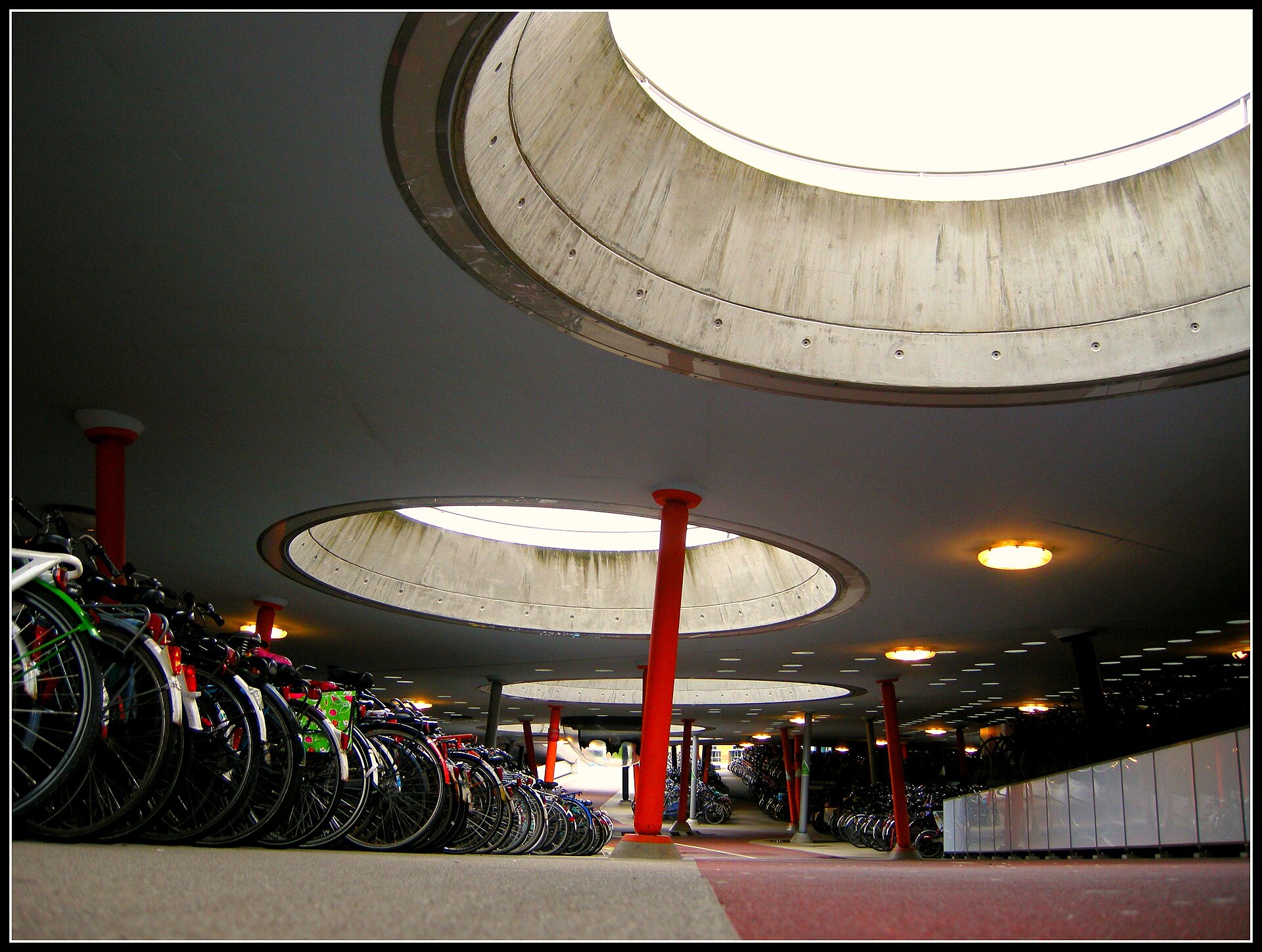
In the red city-centre and station area, Groningen requires bicycles to be left in a rack, marked bicycle bay or parking facility, for no more than 12 days. In the pink-hatched area around the centre, the published maximum is 28 days. A bicycle attached to a convenient railing can still be removed even when it is well locked.
The municipality currently lists a €25 collection fee. For bicycles removed from the city-centre parking area, it also publishes a free 24-hour collection window at the Ossenmarkt depot; other removals may be handled through the Ulgersmaweg depot. Use the municipality’s bicycle lookup first, because cycling to the wrong depot wastes time and the handling route depends on why and where the bicycle was removed.
Housing with private or controlled bicycle storage therefore has measurable value. Record whether the storage has a fixed object for the second lock, whether your contract gives access at all hours and whether a full facility sends residents back onto the street.
Test the route when the lights matter
Dutch rules require a white or yellow front light and a red rear light in darkness or poor visibility; they must not flash. Loose lights are permitted when correctly positioned and visible, and the bicycle also needs the required rear, pedal and wheel or tyre reflectors. Treat working lights as a pre-departure requirement, not as an optional winter accessory.
For the after-dark test, compare the quickest route with the route you would willingly repeat alone after a late class. Note unlit sections, complex crossings, isolated paths, bridge approaches and places where glare or rain hides road markings. If the safer route is five minutes longer, use that time in the annual comparison.
Convert minutes into an academic-year total
Use the attendance weeks in your own programme; 40 weeks is a convenient example, not a universal academic calendar. Suppose Room A takes 18 minutes door to desk and Room B takes 32 minutes, with four return commutes a week. Over 40 weeks, Room A requires 96 hours of travel and Room B about 171 hours—a difference of roughly 75 hours. The arithmetic is:
annual commute hours = one-way door-to-desk minutes × 2 × weekly campus days × attendance weeks ÷ 60
Do not automatically turn all 75 hours into wages. Some cycling time is useful exercise and some bus time is usable reading time; crowded transfers and stressful crossings may have negative value. Write a short note beside the number: “usable”, “exercise”, “unreliable” or “exhausting”. This keeps the calculation honest without pretending every minute feels the same.
Compare rooms with the same worksheet
| Measure | Room A | Room B | Room C |
|---|---|---|---|
| Bike time, door to desk: median / slow reasonable | |||
| Public-transport time: median / missed-connection case | |||
| Campus days and attendance weeks | |||
| Annual commute hours | |||
| Annual bicycle maintenance and equipment | |||
| Annual fallback public transport | |||
| Secure bicycle parking at home / destination | |||
| Last practical evening return | |||
| Route acceptable after dark | |||
| Rent plus commute cost |
Use the same assumptions for every room. If one option is tested in sunshine and another in rain, label the conditions and repeat a test rather than forcing false precision. Keep rent, utilities and commute costs on separate lines before combining them, so a landlord’s attractive headline rent cannot hide an expensive weekly pattern.
Make the decision with explicit failure rules
A room should not win solely because its average ride is fast. Decide in advance what makes an option fail: no secure overnight bicycle storage, no practical late connection, a route you would avoid after dark, or a commute that breaks your work schedule twice a week. Then rank the remaining rooms by total cost, predictable time and the quality of the trip.
Before signing, do one final live check because fares, timetables, roadworks and parking access change. Save a screenshot or note of the route and price used in your comparison, with the date. You are not trying to predict every storm; you are making sure the room still works on an ordinary bad Tuesday.
- Use the exact building, not the campus name.
- Replace example fares with the live planner price.
- Budget repairs from an actual quote and keep a separate parts reserve.
- Confirm DUO entitlement before treating travel as free.
- Reject routes that fail your safety or last-connection rule.
Current data used in this guide
Figures and rules were checked on 27 August 2026. Verify them again when comparing a specific room: OV-bureau Groningen Drenthe 2026 tariff table; BUSgd Voordeel Noord; OVpay check-in and check-out guidance; Groningen P+R ticket; DUO student travel product; Fietscentrum Bus workshop prices; Municipality bicycle-parking rules; municipal bicycle-removal information; Dutch police guidance on checking a used bicycle; and national bicycle-lighting rules.