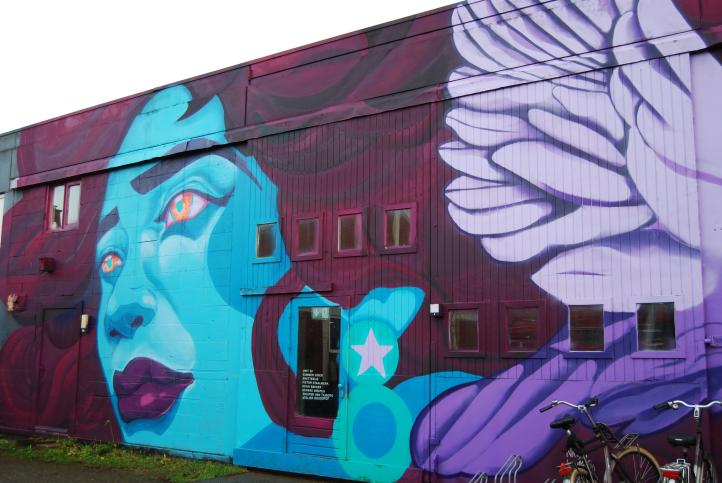
Groningen asks residents to care about their neighbourhoods. The dispute over a mural on the corner of Hereweg and Vechtstraat shows how difficult that invitation becomes when different parts of the municipality send different messages.
Artists from the Toyisme movement began working there in August 2025 on a colourful mural titled Theater van de Droom. OOG’s reporting at the time described an international collaboration, including artists from China, Australia and Romania. A wall in the Rivierenbuurt became the setting for a shared creative project. OOG’s report from August 2025.
The subsequent argument has spread far beyond the painting. It now concerns permits, the condition of a protected building, public spending and whether residents can rely on the encouragement they receive from their local government.
On 20 September, OOG reported that VVD councillor Fokke Veenstra had reconstructed the case using 301 municipal documents released following a freedom-of-information request. According to that account, the municipality itself had suggested the location through Street Art Zuid, while departments later disagreed about the wall’s protected status.
The report also described a proposed €30,000 enforcement penalty, an estimated €25,000 removal cost and a 17 October removal deadline. These figures concern different things: a proposed penalty is not a fine already collected, and a removal estimate is not the total cost of the dispute. The VVD’s interpretation of the documents remains a political assessment, rather than an independent judicial finding. OOG’s report of 20 September.
That distinction matters. So does the question the dispute leaves Groningen having to answer: what harm would removing the mural prevent, and how does that decision fit into the city’s wider approach to protecting historic buildings?
The municipality has offered substantive reasons for its position. During the January debate, housing alderman Rik van Niejenhuis argued that the work did not satisfy the heritage and appearance requirements applying to the building. He also raised concerns that six layers of paint could prevent moisture from escaping.
Residents disputed the technical argument and pointed to the construction of the wall. Van Niejenhuis acknowledged that the municipality had failed to communicate consistently and apologised for the process. Those admissions should be considered alongside the conservation arguments, rather than allowing either side of the story to disappear. OOG’s account of the 14 January debate.
A technical concern requires technical evidence. Establishing whether paint creates a moisture problem means assessing the wall, materials and conditions. Public enthusiasm cannot answer that question, and an aesthetic objection cannot substitute for an engineering assessment.
On 28 January 2026, the council unanimously backed an independent technical investigation into whether the mural could be retained. Removal was put on hold during that investigation. The council also supported a clearer process for future street-art projects, with Kunstpunt Groningen connecting artists and municipal departments. OOG’s report on the council decision.
The public should be able to follow the resulting evidence through to the decision: what was inspected, what was found, which options were considered and why one outcome was chosen.
The same expectation should apply when historic buildings deteriorate.
Heritage protection includes preventing decay. For nationally listed monuments, the Dutch Cultural Heritage Agency explains that owners must carry out the maintenance needed to preserve the building and its historic value. Municipalities supervise compliance and can take enforcement action when a monument falls into disrepair. The agency’s updated maintenance guidance.
National government guidance also explains that authorities can intervene against neglect before it becomes deliberate destruction. The applicable rules depend on the building’s designation; these national provisions do not, by themselves, settle the dispute over a municipal monument on Vechtstraat. IPLO’s explanation of national monument rules.
Politically, however, the standard should be understandable. If protecting a building justifies a costly intervention over paint, residents should also be able to see how authorities respond to leaking roofs, deteriorating masonry and prolonged vacancy.
Proving inconsistent enforcement requires more than photographs of an attractive mural beside an unattractive building. It requires comparable records: inspection dates, identified defects, correspondence with owners, deadlines and completed repairs. Different conditions can justify different responses. Unexplained differences invite distrust.
There is already a starting point for that scrutiny. The province’s heritage monitor tracks maintenance and vacancy, but explicitly acknowledges gaps: some properties are counted without a condition assessment because their owners did not consent to inclusion in that part of the monitor. That limits what the published overview can establish about the whole heritage stock. The monitor’s methodology.
Monitoring also needs to lead somewhere. A condition rating becomes useful to residents when it can be connected to an inspection, a repair plan or an explanation of who must act next.
There are examples of preservation producing a visible result. On 21 September, OOG reported that Dudok aan het Diep had won the project category of the 2026 Heritage Sustainability Award. The former petrol station had been adapted into a café and kiosk, with improvements to its environmental performance. OOG’s report on the award.
That example matters because it gives the debate a practical benchmark: a historic building maintained, adapted and used. Groningen’s heritage policy should be judged partly by how often it achieves outcomes like that.
For students, the Vechtstraat dispute also offers a lesson about taking part in city life. If you want to organise a mural, installation or neighbourhood project, ask for written confirmation of the permissions required for the specific location. Establish who is responsible for each application and obtain the necessary decisions before commissioning work. An encouraging conversation is useful; it leaves important questions unresolved.
Residents following this case should ask for an accessible technical report, a clear account of the legal options and a breakdown separating money already spent from possible future costs. They should also ask how enforcement against deterioration is prioritised across Groningen’s protected buildings.
Those are reasonable expectations of a municipality asking people to trust its heritage decisions. A policy earns that trust through buildings that survive, transparent decisions and residents who can participate without being caught between conflicting instructions.