It is easy to learn Groningen through practical landmarks: the supermarket, your faculty, the place where you left your bike. Its monuments give those routes a different meaning.
This selection brings together historic buildings and commemorative sculptures within the city. You can see all five from outside without buying a ticket, then choose whether to spend a little extra on a tower climb or a church visit. The suggested walking route below connects them in one afternoon.
1. Martinitoren: see how the city fits together
Where: Martinikerkhof 1, beside the Grote Markt.
The Martinitoren is the obvious starting point for understanding Groningen’s skyline. At approximately 97 metres, the tower rises above the centre, but the experience of climbing it happens much closer to its architecture: narrow passages, stone stairs and enormous bells.
There is no lift. The outdoor gallery is about 39 metres above the ground, so a visit does not mean climbing to the tower’s full height. Allow around an hour for the climb, views and descent. From above, try locating the streets you already use; it is a satisfying way to turn a collection of familiar corners into a mental map. Visit Groningen’s tower guide.
The published admission price is €6 for students with a valid student card, compared with €7 for other adults. Check the booking information before leaving, particularly if you plan a late-afternoon visit: entry closes an hour before the tower itself. Tickets and student discount.
2. Aletta Jacobs: a monument that belongs on a student’s route
Where: Oude Kijk in ’t Jatstraat 26, at the Harmoniecomplex.
The bronze bust of Aletta Jacobs deserves a deliberate stop, especially if your daily route already takes you past the university buildings.
Jacobs began studying medicine at the University of Groningen in 1871 and obtained her doctorate in 1879. She became a physician and campaigned for women’s voting rights, women’s healthcare and peace. Her connection to Groningen places the history of access to higher education directly in the streets of today’s student city.
The sculpture, made by Theresia van der Pant in 1988, rewards a closer look. Its surface retains traces of the modelling process, giving the portrait a different character from a perfectly polished ceremonial bust. Kunstpunt documents both the artwork and Jacobs’s history. Aletta Jacobs monument.
There is no admission charge to view the outdoor monument. Make it a short stop before a study session, or bring a visiting friend here when you want to explain something about Groningen beyond its nightlife.
3. Akerk: eight centuries beside the market
Where: Akerkhof 2, at the western end of the Vismarkt.
The Akerk makes a strong impression from the market, but its history becomes more interesting when you separate the building’s different layers.
A chapel stood here around 1200. Fifteenth-century expansion gave the church much of its present form by approximately 1495, while the current 76-metre tower dates from 1711, following the collapse of its predecessor. Inside, look for the historic vault paintings and the Arp Schnitger organ. The Akerk’s history.
For students, the church is also a cultural venue worth following after the first sightseeing visit. Its programme includes exhibitions, concerts and other events, with admission depending on the activity.
For the advertised 2026 summer opening, running until 27 September, ordinary church viewing costs €2. The listed hours are Tuesday–Saturday, 10:00–16:00, and Sunday, 12:00–16:00, subject to event changes. The church specifically announces that it is closed on 20 September. Use the current programme when planning an interior visit. Akerk visitor information.
4. Peerd van Ome Loeks: the station’s horse with an uncertain story
Where: Stationsplein, on the Stadsbalkon outside the main railway station.
If you arrived in Groningen by train, you may already have passed this sculpture while concentrating on your luggage.
Created by Jan de Baat in 1959, the work depicts a horse and its owner in white-painted reinforced concrete. Its angular surfaces and lowered head make it a distinctive subject for a photograph.
The name connects it to the regional song about Uncle Loeks’s horse. The story needs one qualification: its origins, and the accounts of how the horse died, are disputed. Kunstpunt records several versions rather than presenting one as established history. That uncertainty is part of the sculpture’s appeal: a familiar city symbol can carry folklore as well as documented facts. Kunstpunt’s account of the sculpture.
Allow five or ten minutes as a suggested stop. Viewing is free, and it is an easy place to begin a walk when meeting someone arriving by train.
5. Carl von Rabenhaupt: the commander behind Groningen’s August celebration
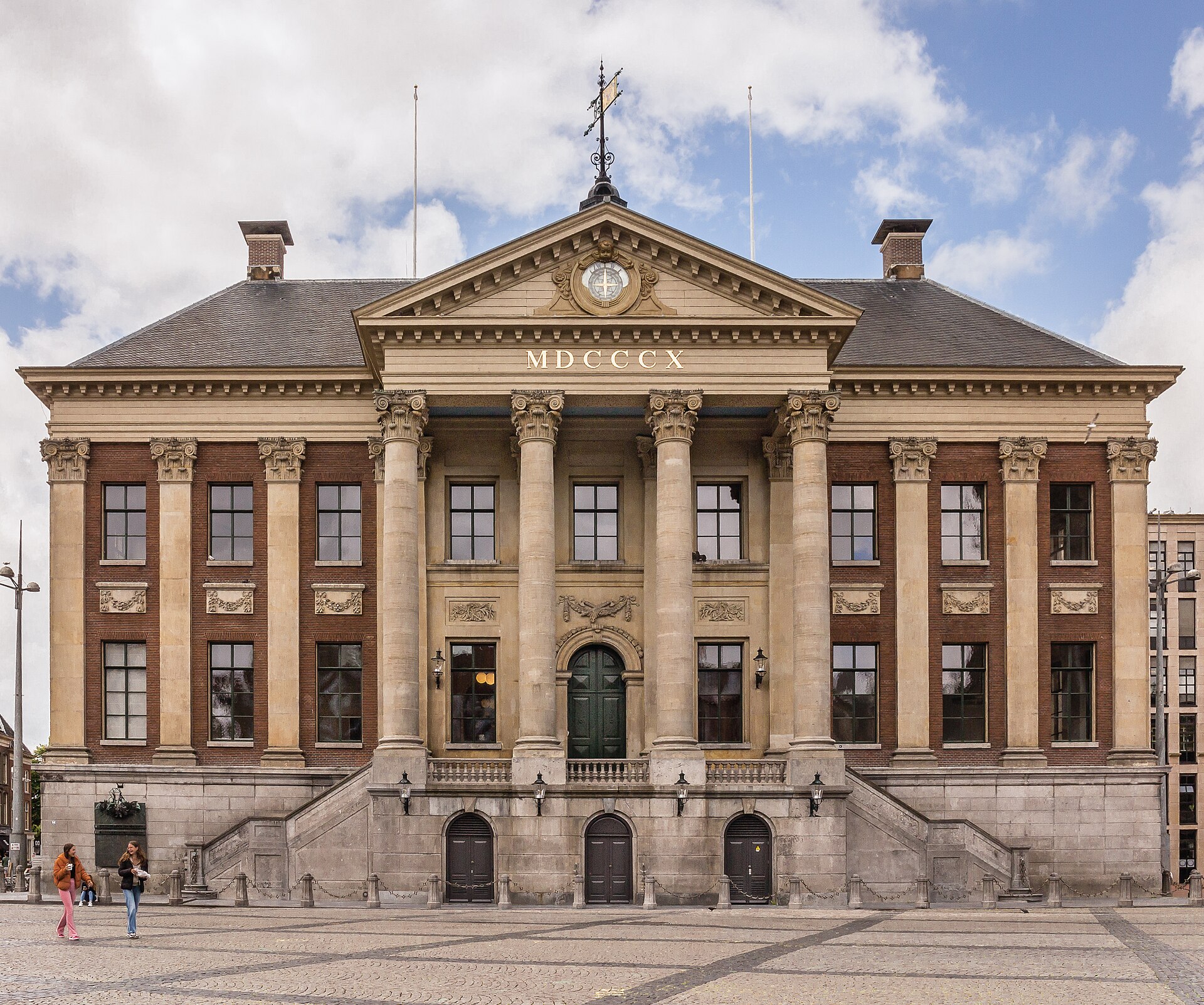
Where: Waagstraat/Waagplein, beside the Goudkantoor behind City Hall.
This bronze bust represents Carl von Rabenhaupt, the military commander associated with Groningen’s successful defence during the siege of 1672.
The end of that siege on 28 August is commemorated through Gronings Ontzet, also known as Bommen Berend. The monument provides a useful connection between a name you hear around the city and the history behind its annual celebration.
Artist Willem Valk made the bust for the 300th anniversary in 1972. Look at the armour and the long seventeenth-century hairstyle: the sculpture identifies its subject through clothing as well as facial features. Kunstpunt’s monument record.
The outdoor monument is free to view. Combine it with the Martinitoren rather than making a separate journey.
To connect all five, start at Peerd van Ome Loeks, cross towards the centre and continue through Folkingestraat to Akerk. Walk north to Aletta Jacobs at the Harmoniecomplex, then head towards Waagplein for Rabenhaupt and finish at Martinitoren.
As a planning estimate, allow around two hours for an unhurried walk with short stops, and more if you enter either building. The outdoor version costs nothing in admission. A student paying the currently listed €6 tower admission and €2 ordinary Akerk admission would spend €8, excluding food and any separately ticketed events.
Visitor information checked on 18 September 2026. Prices and opening arrangements can change; the Akerk price above applies to its advertised summer opening.